
The Wonder of a Wolf-Dog
He was rescued in southwest Missouri, and the moment Paul Flotron laid eyes on him, something shifted. In this deeply personal essay — first published in the St. Louis Java Journal in 2012 — Paul explores the mythology, science, and soul of the wolf-dog hybrid, and what one remarkable animal named Turk taught him about unconditional love.

Originally published in the November 2012 issue of the St. Louis Java Journal. By Paul Flotron, founder of Creature Comforts Great & Small.
Some animals walk into your life and rearrange everything you thought you knew.
Turk was one of those animals.
But before I tell you about Turk, I want to tell you about wolves — because to understand a wolf-dog, you first have to understand what lives inside them. And that story is older, stranger, and more beautiful than most people realize.
The Wolf in Our Imagination
Listening to stories, folklore, and fairytales involving wolves is a common part of our culture — especially when we're young. I grew up with Little Red Riding Hood and The Boy Who Cried Wolf. As a teenager, I alternately laughed and cried my way through An American Werewolf in London and the Academy Award-winning Dances With Wolves.
The wolf has always captivated us. So much so that we've transformed it into mythology — the Werewolf, that shape-shifting creature that lives at the boundary between human and wild. So much so that a celebrated disc jockey named Robert Smith took on the name Wolfman Jack in the 1960s and '70s, howling on the radio to give his broadcasts a character that no one else could replicate. I loved that gravelly voice as much as I loved the music.
What is it about the wolf that holds us so completely?
Revered and Feared: The Wolf Across Cultures
In Native American mythology, the wolf's meaning depended entirely on how a tribe survived. Tribes that hunted revered the wolf as a supreme teacher — patient, strategic, loyal to the pack. Tribes that farmed feared it as a threat to their livestock and livelihood.
In Christianity, the Bible contains 13 references to wolves — nearly all of them metaphors for greed, deception, or destructiveness. "Beware of false prophets, who come to you in sheep's clothing but inwardly are ravenous wolves."
And yet in Native American spiritual tradition, the wolf is considered the highest spiritual teacher — ranked above even the hawk and the eagle. A guide. A protector. A mirror.
Two traditions. Two wolves. The same animal.
What are wolves really like?
The Science of Similarity
Here is what the DNA tells us, stripped of mythology and fear:
Dogs and wolves are 98.8 percent genetically identical.
Geneticists comparing mitochondrial DNA — the genetic material passed unchanged through the mother's line — found identical sequences in both animals. The domestic dog, in all its extraordinary variety, is a direct descendant of the Gray Wolf.
They share a social hierarchy within their packs. Both are family-oriented — they protect their young, care for their sick, and mourn their dead. Both are highly intelligent. Both, in captivity, live between 12 and 14 years. Both are susceptible to many of the same diseases.
The differences are real, but they are differences of degree — not of kind.
And it is precisely this closeness that makes the wolf-dog hybrid so fascinating, so misunderstood, and so demanding of our respect.
The Wolf-Dog: Beautiful, Complex, and Often Misunderstood
The wolf-dog hybrid is growing in popularity as a household companion. And with that popularity comes a responsibility to understand what you are actually welcoming into your home.
First, let's dispel the most common myth: people often seek out wolf-dogs for protection — as guard dogs. This is the wrong animal for that purpose, and the reasoning reveals a fundamental misunderstanding of wolf nature. Wolves, by nature, are shy. They avoid confrontation. They are not aggressive by default — they are cautious, observant, and deeply attuned to their environment.
If aggressive behavior does appear in a wolf-dog hybrid, it is almost always fear-induced. And a fear-driven animal is an unpredictable animal. That unpredictability is not a character flaw — it is a survival mechanism. But it does make wolf-dogs exceptionally challenging for owners who are not prepared.
Wolf-dog hybrids are outstanding athletes. They require enormous amounts of space, stimulation, and exercise. They are still partially wild — and that wildness does not disappear because you've given them a name and a warm bed. Without the right environment, without the right commitment, a wolf-dog will express its frustration in ways that can be destructive and, ultimately, heartbreaking for everyone involved.
The Hardest Truth
Many people adopt wolf-dog hybrids with the best of intentions — drawn in by their beauty, their intelligence, their magnetic presence. But good intentions are not enough.
Without adequate preparation, without the time and space and expertise these animals require, wolf-dog owners have too often found themselves overwhelmed. And when that happens, these animals are surrendered to shelters.
What follows is one of the saddest realities in animal rescue: wolf-dog hybrids form deep, singular bonds with their caretakers. When those bonds are severed — when they are surrendered to a shelter and surrounded by strangers — many of these animals cannot adapt. They cannot form new bonds. And too many of them are euthanized as a result.
I tell you this not to discourage you, but because these animals deserve honesty. They deserve owners who go in with their eyes open.
Turk
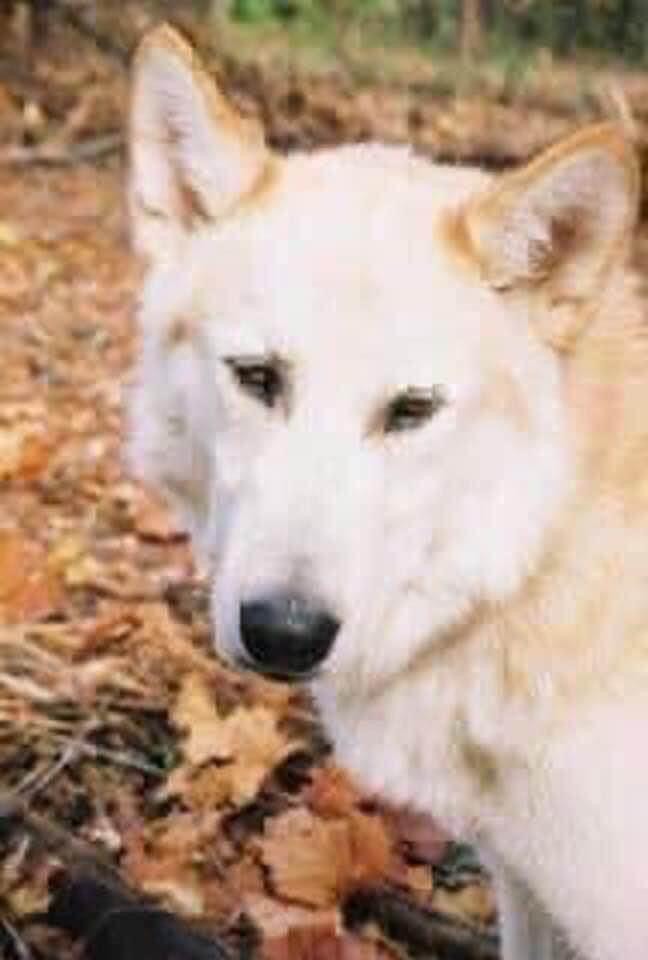
In June, a wolf-dog hybrid was rescued in southwest Missouri.
His name is Turk.
I have been told, over the years, that I am a romantic. I have not always believed in love at first sight. I perceived it as something people said — a beautiful exaggeration, a poetic shorthand for something more gradual.
I now know differently.
The moment I laid eyes on Turk, something in me simply knew. It was not a decision. It was a recognition.
Every moment I spend with Turk deepens what I can only describe as a beautiful friendship — one built on trust earned slowly, on long walks through parks, on the quiet language that exists between a human and an animal who have chosen each other. He is loving. He is sensitive. He is remarkably, almost startlingly, intelligent.
And he is continuously teaching me.
Who Rescued Whom?
I have spent my career caring for animals — domestic and exotic, common and rare. I have seen, again and again, the extraordinary capacity animals have for unconditional love. But Turk has shown me something I did not expect to see so clearly.
He loves freely. Completely. Without reservation or condition.
In the animal rescue community, foster families and forever-home providers often ask the same question, half-joking and half-serious:
"Who rescued whom?"
I used to smile at that question. Now I understand it.
All animals in need occupy a special place in my heart. But Turk has claimed a particular corner of it — the one I didn't know was empty until he filled it.
He deserves the best care I can give him.
As do all of our pets.
Paul Flotron is the founder of Creature Comforts Great & Small, a premium pet care service based in St. Louis, Missouri. He has been caring for domestic and exotic animals since 2009. This essay was originally published in the November 2012 issue of the St. Louis Java Journal.
Explore Topics
Written by
Paul Flotron
Owner & Founder of Creature Comforts Great & Small, LLC — St. Louis's premier in-home pet care specialist with 17 years of experience caring for animals of every species, size, and temperament.


